What a Green Bay Site Needs in 2026
 Posted by: Admin on 27th October 2026 16:05:08.
If you run a shop, trade, clinic, or service business around Green Bay, De Pere, or the Fox Valley, you already know people check you on a phone before they call. The question is whether your site helps them — or quietly sends them to the next listing.
I have been building websites for Wisconsin small businesses and nonprofits since 2007. The sites that still work in 2026 share a short list of habits. None of them require a huge budget. All of them respect a busy customer.
It has to work on a phone first
Most of your visitors are not at a desk. They are in a truck, in a kitchen, or standing in a parking lot in Ashwaubenon looking for someone who can help today.
On a phone, your site should:
- Load without a long wait on regular cell service
- Show your phone number as a tap-to-call link near the top
- Keep buttons big enough for a thumb
- Avoid tiny text that forces pinch-and-zoom
If someone has to hunt for how to reach you, many will not. They will tap the next business that made it easy.
Say what you do in the first screen
Open your home page on a phone. Cover the logo with your hand. Can a stranger in Allouez still tell what you do and where you work?
Plain words beat clever slogans. "Roof repair in Green Bay and nearby towns" is clearer than a vague tagline. Name the service. Name the area. Then offer the next step.
One clear next step
Every important page needs a clear call to action. That usually means:
- Call us
- Text us
- Send a message
- Request a quote
Pick the action that fits how you actually work. A plumber may want tap-to-call. A nonprofit may want a donation or volunteer form. A shop may want hours and directions. Do not bury the action under three paragraphs of history.
Speed is part of respect
Heavy photo galleries, auto-play video, and leftover plugins slow a site down. A customer on lunch break will not wait for a spinning wheel.
Practical speed habits:
- Compress photos before you upload them
- Use real photos of your work, not giant stock banners
- Keep the home page focused — home, services, about, contact is enough for many owners
- Remove pages and widgets nobody uses
A lean site feels more trustworthy than a slow one that tries to look expensive.
Match your listings
Your website name, phone, hours, and service area should match your Google Business Profile. When they disagree, customers get confused and search tools get confused too.
Update holiday hours, winter hours, and "by appointment" notes in both places. A locked door after a web search is a hard first impression.
A quick check you can run this week
Grab your phone and open your site on cell data, not Wi-Fi.
- Can you tell what the business does in about ten seconds?
- Can you tap to call without scrolling forever?
- Do the hours and town match what you tell people?
- Does the page feel snappy, or do you wait?
Write down what failed. That list is your redesign brief — whether you fix it yourself or ask for help.
If you want a hand
Real Wisconsin Website Design is a veteran-owned and woman-owned company in Green Bay. We build practical sites for Wisconsin small businesses and nonprofits — the kind a customer can use between jobs.
If you want a plain-language look at what your site needs next, call 920-785-1219, text 920-461-3129, or use the contact form at https://realwis.com/contact-form.php.
Jim Murphy
Real Wisconsin Website Design
https://realwis.com






Why a Real Website and Business Email Still Beat Social-Only
Posted by: Admin on 27th October 2026 15:56:40.
If you run a shop, trade, or service business around Green Bay, De Pere, or the Fox Valley, you have probably heard this: "Just stay active on Facebook. That's enough."
I hear it a lot. Social media is useful. It is not a storefront.
I've been building websites for Wisconsin small businesses and nonprofits since 2007. The businesses that keep getting found, trusted, and hired still have two plain things in place: a real website they control, and email that ends in their own domain name — not @gmail.com or @yahoo.com.
Here is why that still matters, in everyday terms.
Social accounts are rented space
When your only "website" is a Facebook Page or an Instagram profile, you are on someone else's land. The layout changes. Reach goes up and down. A post that worked last month can vanish in the feed this month.
A customer who heard about you from a neighbor often types your business name into Google. If the top result is a thin Facebook Page with old hours and no phone that works on a phone screen, many people keep scrolling. The plumber two towns over with a clear site and a tap-to-call button gets the job.
Your own site does not depend on an algorithm feeling generous that day. You decide what it says, how it looks on a phone, and what happens when someone wants to call you from Howard, Allouez, or Ashwaubenon.
A website answers the questions people actually ask
Before someone calls a contractor, clinic, or shop, they want a few basics:
- What do you do?
- Where do you work?
- How do I reach you?
- Are you open when I need you?
A short, honest website can answer those in under a minute. Social profiles are built for scrolling and chatting. They are awkward for hours, service areas, and "do you come to Bellevue?"
When Google or an AI tool looks for a local business to recommend, it leans hard on a clear website plus a matching Google Business Profile. A Facebook Page alone is a thin signal. Your site is the place you can say, in plain words: we serve Green Bay and nearby towns, here is what we do, here is how to get in touch.
@yourdomain email looks like a real business
Picture two quotes in your inbox. One comes from mike@gmail.com. The other comes from mike@yourbusinessname.com. Same person. Different first impression.
For a homeowner hiring a remodeler, a nonprofit choosing a vendor, or a shop owner getting a quote, the domain email reads as "this is a business." A free webmail address is fine for personal use. For invoices, estimates, and follow-ups, it undercuts the trust you are trying to build.
Business email also keeps work mail in one place. When staff changes, the address stays with the company. You are not hunting through someone's personal Gmail for last year's estimate.
You do not need a fancy setup. A domain you own, a simple mailbox or two, and the same name and phone on your website and listings are enough to start.
What "good enough" looks like for a local business
You do not need a 40-page site. For most Green Bay and Fox Valley owners, a lean site works:
- A home page that says what you do and where you work
- A services or about page with real detail, not filler
- A contact page with phone, email, and a form that works on a phone
- Hours and service area that match your Google Business Profile exactly
Pair that with email at your domain. Keep Facebook or Instagram for updates and photos if you like them — as a support channel, not as the only place a stranger can learn who you are.
If a stranger in De Pere cannot tell what you do, where you work, or how to call you in about ten seconds, fix that first. Fancy graphics can wait.
A quick check you can do this week
Open your phone. Search your business name. Then search the service plus your town. Ask yourself:
- Does a real website show up, or only social profiles?
- Do the phone, hours, and town match what you tell customers?
- When you email a customer, does the address end in your domain?
If the answers are shaky, you already know the next step. You do not need to rip everything apart. Start with a clear site and professional email. Keep social for the conversations it is good at.
If you want a hand
Real Wisconsin Website Design is a veteran-owned and woman-owned company in Green Bay. We build practical websites for Wisconsin small businesses and nonprofits — the kind a customer can use on a phone between jobs.
If you want a second set of eyes on your site, your listings, or getting email on your own domain, call 920-785-1219 or use the contact form at https://realwis.com/contact-form.php. We will tell you, in plain words, what we would fix first.
Jim Murphy
Real Wisconsin Website Design
https://realwis.com
Try This 10-Minute Test Before Your Next Customer Does
Posted by: Admin on 19th October 2026 10:18:57.
Here’s something I'd like you to try tonight.
Pick up your phone, open ChatGPT, and ask it what a new customer would ask: "Who’s the best [what you do] in [your town]?"
Then read the answer slowly. Is your name in it? Is a competitor’s? If you do show up, are your hours and services right?
I’ve been building websites for Wisconsin small businesses and nonprofits since 2007, and this is the quickest reality check I know.
More people now ask an AI tool for a recommendation instead of scrolling through Google, and those tools usually hand back only a few names.
What I want you to know:
- The AI tools aren’t guessing. They rely on what your website, Google and Bing profiles, and reviews say about you.
- Small mismatches matter. An old phone number on a forgotten listing can be enough for an assistant to pass you over.
- Most of the fix is work you can do yourself, a little at a time.
I wrote out the whole tune-up, step by step, in my new article:
When Someone Asks ChatGPT "Who Should I Hire?", Will Your Name Come Up? https://realwis.com/ai-visibility-who-should-i-hire.html
Like to work with a pen? There’s a free one-page checklist you can print and mark up: https://realwis.com/ai-visibility.html
Run the test this week. If the answer surprises you, the article shows you where to start.
Jim Murphy, Real Wisconsin Website Design, veteran-owned and woman-owned, Green Bay
Google ran a spam update on September 24. Here is the 20-minute check for a Green Bay business.
Posted by: Admin on 29th September 2026 15:48:01.
Google started a global spam update on September 24, 2026. The rollout can take up to about two weeks, so the picture may still be moving through early October.
If you run a shop, trade, clinic, or nonprofit in Green Bay, De Pere, or the Fox Valley, do not rip the website apart this week. Do a short check. Then fix only what is actually weak.
**What this update is really about**
Google is again pushing down pages that exist mainly to rank, not to help a person choose a business. That includes:
- Near-duplicate city pages that only swap “Green Bay” for “Ashwaubenon”
- Thin AI pages with no local detail
- Service pages that could belong to any company in any state
- Listings and website details that do not match
Using AI to draft is not the problem. Publishing low-value pages at scale is.
**The 20-minute check**
1. Open Google Search Console. Look at performance from September 17 through today. Note whether clicks or impressions dropped, and on which pages.
2. Open the Manual actions report. If it is empty, you do not have a manual penalty.
3. Open the Security issues report. Rule out a hacked site before you blame SEO.
4. Pick your three money pages: home, main service, contact. Read them out loud. If a stranger in Allouez can’t tell what you do, where you work, or how to call you, those pages need work.
5. Compare your website name, address, and phone to your Google Business Profile. They must match exactly.
If traffic is flat and those five items look clean, wait until Google marks the rollout complete. Do not rebuild the site on a hunch.
**The doorway test for city pages**
If you have a page for every nearby town, swap the city name in your head.
- If nothing else on the page would have to change, that page is thin.
- Keep pages that prove real work in that place: a photo from the job, a review that names the town, a note about the actual service area.
- Merge the rest into one strong service page that lists the communities you actually cover.
A plumber who works Green Bay, De Pere, and Howard is better off with one honest service-area page than eight copy-paste city pages.
**What still helps a local business**
This has not changed, and it matters more when Google is cleaning spam:
- One consistent name, address, and phone everywhere
- A complete Google Business Profile: hours, services, categories, real photos
- Reviews that mention the service and the town
- A mobile site that loads and has tap-to-call
- Pages written like a person who has done the work here, not a template
Update holiday hours, winter hours, and “by appointment” before customers hit a locked door.
**What not to do this week**
- Do not buy a package of 50 blog posts.
- Do not create new city pages just to “cover more towns.”
- Do not change the domain, theme, and phone number at the same time. You will not know what caused a drop.
- Do not ignore a real problem because “Google will sort it out.” Thin pages and mismatched listings are on you.
**If you want a second set of eyes**
RealWis can review the site, the listings, and the profile the same way we do for other Wisconsin small businesses and nonprofits. Call 920-785-1219, text 920-461-3129, or use the contact form on Real Wisconsin Website Design.
How Green Bay Businesses Show Up in AI Answers
Posted by: Admin on 18th December 2022 17:23:08.
Here is the honest update. It didn't replace Google. Instead, it added a second way people find businesses. Today, some customers type a question into ChatGPT, Gemini, or Copilot, or read the AI Overview at the top of a Google search, and get a short answer that names a few local businesses.
So the real question for a Green Bay business or nonprofit is simple: will your name come up, and what can you do about it? The good news is that you don't need tricks. Google is still the main way local customers find you, and AI answers are built on the same foundation as a good Google listing.
Where AI Answers Get Their Information
AI tools don't know your business personally. They put together answers from what they can find and read online. For a local business, that usually means:
- Your own website, especially pages that clearly say what you do and where
- Your Google Business Profile, with your hours, phone number, photos, and reviews
- Directories and review sites where customers talk about you
- News stories, local mentions, and links from groups you belong to
In other words, if your information is clear, correct, and the same everywhere, AI tools have a much easier time understanding you. If it's missing, out of date, or doesn't match from place to place, they may skip you and name someone else.
What Helps a Local Business Get Mentioned
None of these steps guarantees a mention. But each one helps your chances, and every one of them also helps you on regular Google search.
- Clear pages. Say plainly what you do, where you work (Green Bay, De Pere, the Fox Valley), and how to reach you. Don't make a reader, or a computer, guess.
- The same details everywhere. Use the same business name, phone number, and service area on your website, your Google Business Profile, Facebook, and directories.
- Real reviews. Ask happy customers to leave an honest review on Google and other trusted sites. A steady trickle of real reviews beats a sudden pile.
- Answers to real questions. Think about what customers ask you on the phone, such as cost, timing, and service area, and answer those questions in plain words on your pages.
- Clean behind-the-scenes details. Structured data is a small bit of hidden code that tells search engines your business name, hours, and location in a format they can read easily.
- A site that works for everyone. Your website should load fast, work well on phones, and be accessible to people with disabilities.
A 15-Minute Self-Check You Can Do This Week
You can do this yourself with a cup of coffee and a web browser.
- Ask ChatGPT and Google something like "best [your service] in Green Bay" and see if your business comes up. Try it a couple of different ways.
- Open your Google Business Profile and your website side by side. Check that your name, phone number, hours, and service area match.
- Read your home page as if you were a stranger. Within a few seconds, can you tell what the business does, where it works, and how to get in touch?
If you come up and everything matches, great. If not, write down what was wrong. That list is your starting point.
What Not to Do
When something new comes along, shortcuts pop up fast. These can do more harm than good:
- Copy-and-paste city pages, where the same page is repeated with only the town name changed
- Filler pages written by AI just to have more pages, with nothing useful in them
- Buying reviews or trading favors for fake ones
Google treats this kind of thing as spam, and AI tools lean on the same signals. For more, see our post on Google's September spam update and the 20-minute check for Green Bay businesses: https://blog.realwis.com/blog.php?blogpost=32
Where to Go From Here
The steady path works best: a clear website, matching listings, real reviews, and pages that answer real questions. Do those well and you help your chances on Google and in AI answers at the same time.
If you'd like a simple list to work from, grab our free AI and voice search checklist: https://realwis.com/ai-visibility.html
You can print it and check things off with a pen. For a longer walk-through, read When Someone Asks ChatGPT "Who Should I Hire?", Will Your Name Come Up?: https://realwis.com/ai-visibility-who-should-i-hire.html
If you'd rather have someone handle the technical side, that's what we do. Real Wisconsin Website Design is a veteran-owned and woman-owned web design company in Green Bay, and we've been building websites for Wisconsin small businesses and nonprofits since 2007. That includes the websites for Green Bay DAV Chapter 3 and the DAV Department of Wisconsin, which you can see in our portfolio: https://realwis.com/portfolio.html
Send us a message (https://realwis.com/contact-form.php), call us at 920-785-1219, or text us at 920-461-3129 (text only). We'll take a look at how your business shows up and tell you, in plain words, what we'd fix first.
1. Website Design
2. SEO
3. Local Marketing
4. ADA & Accessibility
5. Content & Video
6. AI for Small Business
7. Nonprofit & Small Business
8. How-To / Checklists
GENERAL
TECHNOLOGY
WELCOME

15-Minute Monthly Listing Check
Posted on 27th October 2026 16:15:30 by Admin.
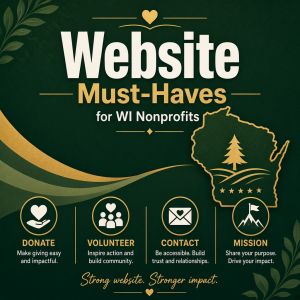
Website Must-Haves for WI Nonprofits
Posted on 27th October 2026 16:13:50 by Admin.

Short Video + Your Website Working Together
Posted on 27th October 2026 16:12:18 by Admin.
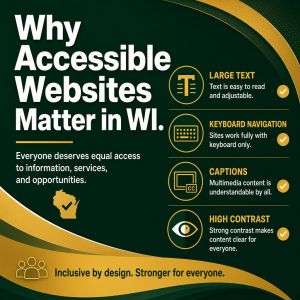
Why Accessible Websites Matter in WI
Posted on 27th October 2026 16:10:31 by Admin.
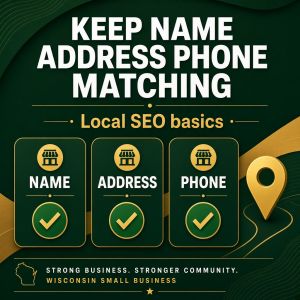
Keep Your Name, Address, Phone Matching
Posted on 27th October 2026 16:06:55 by Admin.
